
|
How to Remove Odors From Booksby Craig Stark 22 July 2026 |
In March, 2008, some 18 years ago, BookThink published an article on how to remove odors from books using an ozone generator. From a strictly personal viewpoint, I
would count the issue of odor removal among one of the most frequently posed questions on just about any media platform that addresses books and/or ephemera - still. It
never goes away. And I suspect that it comes up more often now than ever because older books are continuously absorbing odors we wish weren't present. Surely the population
of untreated books just grows and grows.
It's also, IMO, one of the most unsatisfactorily answered questions. Various treatments of exposing problem books to baking soda, cat litter, charcoal and other odor-absorbing
substances are still among the more common answers, and to my astonishment things like dryer sheets are still tossed out there, as are substances whose purpose is to mask odors with
more pleasing(?) aromas. And please don't get me started on freezing books (though this does have its place in uncommon situations). The truth is, if any of these methods work at
all, most of them act very slowly, and Job's patience itself might be necessary to wait for a suitably acceptable elimination.
Now, I've successfully used an ozone generator for many years and will continue to do so. It's fast; most treatments take less than a day, sometimes only a few hours, and the
results are permanent. And by permanent, I mean the odors - and their sources - are gone and will not reactivate.
However. I need to stress something here that, in my first article, I perhaps didn't stress as strongly as I might have. Caution needs to be exercised. The protocol needs to be
strictly followed, and if you have any existing pulmonary issues, extreme caution may need to be taken, if not altogether looking for a more health-friendly approach, which
will follow this discussion.
The good news:
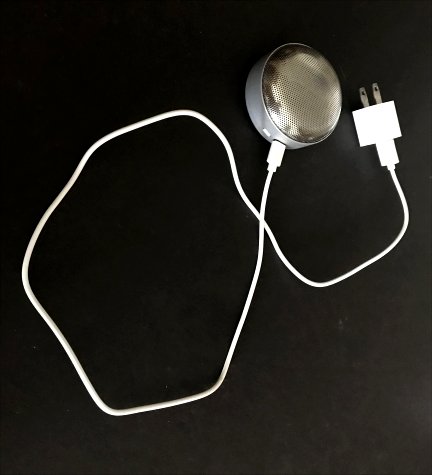
Ozone generators, once somewhat difficult to find, today are readily found in the marketplace - Amazon is a good starting place - and they are available as low-wattage, mini
generators, a little smaller but much lighter than a hockey puck, which fits in the palm of your hand. And they're cheap. BTW, Wattage should be low - 3W only in my generator -
and features should include an automatic shut off that can be increased to longer periods of time, but not significantly longer, starting at about half an hour and potentially increased
to close to an hour. You definitely want this feature to eliminate the possibility of long term exposure, also for small objects like books, etc. You absolutely do not need anything
more powerful. Also, the ozone itself is unstable and will convert back to harmless oxygen in one to two hours after shutting off your unit. My device can be both plugged in or
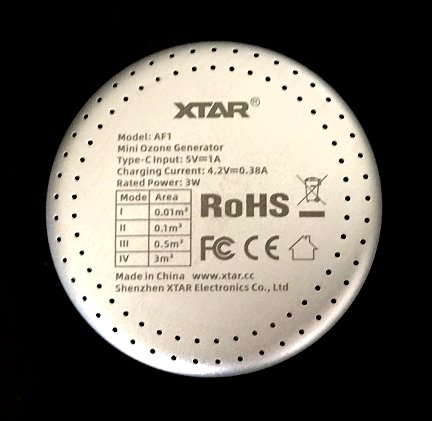
operated on a rechargeable battery. When purchasing, look for the following three certifications:
1. CE (Conformite Europeenne): Confirms the device meets European Union safety, health, and environmental protection requirements.
2. FCC (Federal Communications Commission): Guarantees the internal electronics do not cause harmful electromagnetic interference with other wireless devices.
3. RoHS (Restriction of Hazardous Substances): Certifies that the physical materials used to build the device (like the casing and circuit boards) are free from dangerous
levels of toxic substances like lead, mercury, and cadmium.
This photo shows the back of my unit with all three certifications clearly marked. Don't buy anything that isn't certified.
The careful news:
There are potential health hazards. Ozone is essentially a bleaching agent, effective at oxidizing organic matter - and that includes you. Though 3W is low and may be harmless
when inhaled for short periods of time and at lower concentrations for most of us, it's not generally good for those with pulmonary issues, so the protocol you use must safeguard
against the worst case scenario. The EPA posts studies that indicate that higher concentrations must be avoided, but so as not to scare you off totally from considering this method,
I should note that smaller concentrations exist in the atmosphere, naturally and variably, depending on atmospheric conditions, and we breathe it in every day.
For books, use it only in small containers that can approach 95% or more air tightness. A better quality cooler, for example, ensures this if it is advertised as waterproof and
has clamps on all four sides, doubled on the long sides. Even so, I cannot generally recommend using this inside, in any interior room, sealed or not. Instead, put it on a porch outside
or in a vacated, well-ventilated garage or storage shed. Also, the potential harm it can cause applies to pets and plants.
More considerations:
To minimize the time required to work satisfactorily, I highly recommend using a portable, battery-operated fan placed inside the container along with the battery-operated
generator, and facing the outer edge of the text block. Usually this requires opening the book and standing it up. This will have the almost magical effect of fanning open an
otherwise tight book so that the ozone can more quickly do its job. Here is an article from a 2012 BookThink article that illustrates it >>>
----------------------------------------------------------------------------------------------------
By Craig Stark
What's that line from the Beatle's "Mother Nature's Son"? "Swaying daisies, sing a lazy song beneath the sun." Ah, now that the languorous days of summer are approaching, this
might be a good time to discuss a method of deodorizing books that I've had success with and in fact uses Mother Nature.
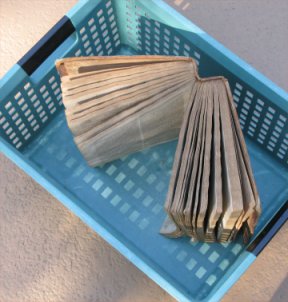
This method takes advantage of a phenomenon you might not be familiar with. For lack of a better term, I'll call it the fan effect. If you stand a book upright and open it, it will
usually separate into sections of leaves, like this:
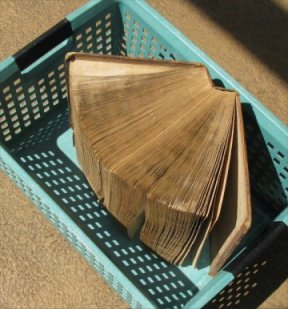
If you're doing this to air the book out, it doesn't work all that well. It's almost impossible, in fact, to fan the leaves out. But something magical happens if you face the
book into a gentle breeze:
Within minutes the breeze gently opens all of the leaves with remarkable uniformity, exposing each down to the gutters to both fresh air and sunlight, allowing the sun's
ultraviolet rays to do their thing. If you do this with books that smell musty, smoky, etc., many odors will be either greatly reduced or eliminated altogether within one
to three afternoons of exposure. If there's no breeze, a fan switched on low will accomplish the same thing.
Some words of caution:
Sunlight can fade a book's cover in pretty short order, so take care to position the cover away from the sun - and besides, you'll want the fanned leaves to face the sun
anyway to maximize its odor reducing powers. Sunlight can also fade some types of text, but typically inks used to print books require much longer exposure times to be significantly
affected.
Unless you can rig a totally sealed entry hole into the container, forget about using anything that requires a plug. Any cord that passes outside the container will likely compromise
the seal on the lid. Test the fan first for ten minutes or so to make sure it will achieve this fanning effect. If it doesn't, placing spacers between the leaves will achieve a
similar result. I use 14" zip ties, which works on most books. Of course, the generator goes in last.
----------------------------------------------------------------------------------------------------
Once the pre-set running time expires, open the lid, leave the area, and let the container air out for at least an hour to allow the ozone to convert back to oxygen. When you return,
do a sniff test. If the air still has a bleach-like scent, leave again and give it more time. BTW, this is a familiar scent if you've ever gone outside shortly after a thunderstorm. If
the book requires a second or third treatment, spend as little time as possible to reset the generator and replace the lid for a second treatment, and leave again. Air out again. Be safe
again.
Final thoughts:
Obviously, paper is manufactured in countless thicknesses and porosities. Some of it is coated, glossy or not, and is less inviting to ozone penetration. Treatment times will therefore
vary. Many books will require only one treatment, others perhaps two. The most treatments I have ever had to use were three. After some experimentation, you'll be much better at
estimating this.
Apparently there is at least some potential for damaging a book if it is over-treated. It's been reported that a few fabrics and some papers can be adversely affected by ozone,
also some dyes used to color them, glues, etc. The risk seems small overall if treatment is minimized - I've never had an issue with this - but it's there nonetheless.
What about mildew or mold? If you're going to zap books with these infestations, yes, a generator can eliminate the odor, theoretically, but if you don't get it all - and how will
you know if you do? - where are you? At an ethical crossroads. Though odds are somewhat slim, a small number of remaining active spores (which would be difficult to detect by smelling)
could eventually propagate into a big problem. If the book travels to another library, it could spread the problem to other books. It's one thing if you're risking a book you plan to
keep, quite another if you're selling it.
A final warning: Do make the effort to investigate the potential for ozone generators to adversely affect your health before you do anything else. Also explore methods to eliminate
these risks. There's far more information about this online today, and I can't emphasize enough that the responsibility for whatever happens is on you and you alone. Whatever you do,
do not plunge ahead blindly solely on the basis of this article. Consider this BookThink's formal disclosure.
MicroChamber paper:
If you haven't heard of MicroChamber paper and have a valuable or semi-valuable book or two with any unpleasant odor - smoke, "basement" odor, mildew, etc., you might want to try this.
This ultra-thin paper is used by book conservators, museums, serious comic book collectors and other interested souls to completely and permanently remove odors. It also slows and/or
stops the progression of damage from acidic paper, which of course has been used for many years to print books on the cheap, much to our chagrin. Note that it will not treat active
mildew or mold, only the odors emitted from them, so this will be needed to addressed first.
Briefly, MicroChamber paper uses something called SPZ zeolite technology, a proprietary process that literally traps volatile organics permanently. (I'll leave it to you to seek more
information on this.) It works with any paper product. If used on a book, individual sheets are inserted between pages and can be spaced out some and still accomplish deodorization,
though the fewer sheets used, the longer things will take. Unlike ozone, it's safe to handle and breathe, and it's archival; it won't harm or discolor the paper it's used on.
Sounds good so far? There are some downsides. There is a limit to how much a single sheet will absorb, whereupon it will be saturated and stop working, though happily it will not
release anything that it has already trapped. I haven't to date experimented enough to give you a feel for how many sheets to use in a book or how long deodorization will take. Obviously,
this will depend on the type of paper and the intensity of the odor, but clearly, unlike ozone, it will not happen in an hour or two. A few weeks may be more in the ball park. So far
I've simply used it as suggested, inserting some sheets into a book and sealing it tightly in a Ziploc bag. It can be used without sealing it, but this will greatly speed up its saturation.
Another downside is cost. Look to pay $.50 to $1.00 a sheet. This matters only if the sheets can't be used multiple times or if many sheets are required to achieve the desired result.
I'm still experimenting. One particular experiment I'm anxious to try is to set things up in a container, similar to the ozone generator protocol, with a book fanned open and a fan blowing
on it. Since the sheets will be loosely inserted, I suspect that I might have to secure them to the leaves in the book with something benign like soft plastic paper clips. In any case,
I'm guessing this might speed up the process significantly - and of course you can do this inside in any room.
An update will follow as soon as I get further along in my experimentation.
Click here for more details.
Forum
| Store
| BookLinks
| BookSearch
| BookTopics
| Archives
Copyright 2003-2026 by BookThink LLC
site by
The Poor Man's Method of Removing Book Odors
Questions or comments?
Contact the editor, Craig Stark
editor@bookthink.com
Privacy Policy & Disclaimer
Advertise
| AboutUs
| ContactUs
| Search Site
| BookShelf
| BookThinker