
|
AI'S Part to Play in Bookselling:by Craig Stark 25 May 2026 |
Some Thoughts About and a Specific Experience With a Recent BookThink Project on The First Edition Library
Perhaps no other invention has impacted the bookselling trade over the last 20 years or so than bar code scanners. Already some of us carry devices that, with the click of a
button, can instantly deliver information on any book with a bar or QR code and give us advice on buying it for resale. Depending on the vendor, this information varies on accuracy,
detail and both depth and breadth of sources from which it's compiled. Is it too much to assume that this technology will soon advance to include historical pricing on innumerable
books sold across many venues over many years, not just Amazon and perhaps a few others? Could this technology extend to factoring in condition and other aspects of books that
ffect potential outcomes? Could cameras working off snapshots of title or copyright pages help the cause?
I suspect that these answers will arrive eventually, if not soon, and if they do, it will certainly alter the already fluid landscape of bookselling, if not altogether eliminate
the need for an apprentice bookseller to learn much about the value books at all, at least in the process of selecting what inventory to buy and what to leave on the table.
And keep in mind that I'm talking about what these technological advances can plausibly deliver in the near future. It would necessarily be improved information, yes, but this
information is inevitably limited to one specific format: numbers. It's all about numbers. And numbers do not extend to a human encounter with a book that identifies factors that
can't be measured in numbers but can very easily identify what can affect values, often hugely. Here are three examples: A single snapshot cannot smell mold, feel how loose a binding
is or turn pages to determine completeness.
And what about selling? This is muddier. A few things come to mind. AI works with data, not intuition. Intuition is a difficult thing to define in concrete terms, but in my
experience, despite my inability to put it simply into AI-level words, it's been crucial to my own success (and instances of failure) as a bookseller. I know a few things about it.
It's a quiet, almost inaudible voice that can arrive without any measurable sound but nevertheless it's communicated, more as a brightness that inhabits one's entire being. A light
going on? I also know that its power is cumulative and can be enlarged and refined from past experiences. Furthermore, it's born into us in different forms than can't help but lead to
idiosyncratic outcomes.
But here's a hard stop for you, something I can define. AI seems to be picking the low-hanging fruit first, the data that's publicly available to most anybody. There's a ton of
information about books and bookselling online, free to access, organize into answers and apply to your own business, at your own peril. There are some copyright issues looming darkly
in this, of course, and perhaps they will be solved, in part or whole, under, for example, "Fair Use" copyright law.
But what about paywalls? Resources that require several criteria to be met before one gains access? Perhaps the most obvious of these is money. Some of the more valuable
bookselling information I know of is locked behind paywalls that require hard cash if one wants to use them. Already there are efforts underway to circumvent this, of course. The
intent of this article isn't to explore them, but I'll list four that are evolving as we speak, and you can dig in further if you're inclined.
1. Agentic AI browsers
2. Fragment-based reconstruction
3. Technological evasion
4. Third-party AI summarizers
All forms of hacking, these are, some more pernicious than others.
For me this hits home at BookThink. For 23 years now I've been operating a monetized online resource which has grown a small mountain of paywall protected bookselling information
that's available to others only at a price. If AI could hack into my paywall, I'd be halfway to shutting down. Or, if BookThink print publications, which are already floating around,
could be legally scanned, shot into cyberspace and sold for profit without our permission, it might be over.
We'll see how it plays out. For the moment, AI is free to grab the fruit it can and often, so often, frustrate us with a pretty unpalatable mouthful of junk food. Just this month I
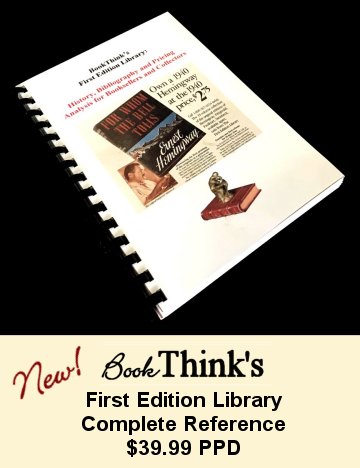
completed a new publication on the First Edition Library (a group of books that were issued first in the 1990's as near exact facsimiles of their original first editions, dating back
to the late 1800's and forward into the 20th century) that proved frustrating at many turns.
Many of you may recall that years ago we offered a checklist version of this publishing event that was first issued only as a checklist with a shallow-dive informational article
attached to it, then later improved somewhat with accompanying icon-sized illustrations, then retired. The version I just completed mined next to nothing from it except the titles
that appeared in the original checklist and only a smattering of details from the attached article that could still be verified as reliably true. And yes, our checklist included
occasional errors, even in several of the titles. The current version includes a much expanded reference guide to the FEL, including its publishing history in depth, a complete set
of identification tools pertaining to both participating publishers, a full bibliography including enlarged illustrations of all dust jackets with publisher's issue data, and more.
It's available for purchase here or on the home page.
As for pricing FEL books, sorry, I've been deliberately vague and relied heavily on spreads of outcomes I've observed. And that pesky factor of intuition always comes into play.
What's clear is that FEL's have been relentlessly collectible for a long, long time, and will likely remain so. This valuation phenomenon is somewhat scarce in the marketplace. May
the time I spent on this project be worth something!
Lastly, what I'm trying to get at primarily is the frustration I experienced in compiling information that never sat on a pig's back. A lot of the AI junk was doubtless the result
of piggybacking from one seller to the next. I noticed it perhaps most often in, of all things, the number of FEL titles issued. AI asserted over and over again that there were 112,
when in fact there were 111, #112 being a planned project that was never completed. Confirming the titles that Easton Press purchased copyrights to was another example, and just as
I was about to give up, I got my hands on a booklet published by Easton with a full, verifiable list.
Other discoveries happened as well, including a few misunderstandings about Otto Penzler's participation in the FEL mystery titles, which triggered more than one argument over
first edition identification, and in the literature titles, even the discovery of a dust jacket that was thought for decades to have never been produced. And don't get me started
on dust jacket variants without a whisper of established priority - the FEL was guilty - and don't forget to remind me why Kurt Vonnegut's Player Piano, which many blithely assumed
was a Science Fiction novel at the outset, later rose to the more erudite FEL category of literature. Oh, and adorably, there are some so-called FEL facsimiles of first editions that
weren't copied from the true first editions at all! I'm confident that AI will be self-correcting over time, something like Wikipedia on steroids, but the question remains, How
long will it take and how much will it impact you as a bookseller? Me? I'm hoping for an assist from a thundering herd of mice.
Forum
| Store
| BookLinks
| BookSearch
| BookTopics
| Archives
Copyright 2003-2026 by BookThink LLC
site by

Questions or comments?
Contact the editor, Craig Stark
editor@bookthink.com
Privacy Policy & Disclaimer
Advertise
| AboutUs
| ContactUs
| Search Site
| BookShelf
| BookThinker