Where Love Has GonePart V: Case Study #2, The Annoying Mystery of the May 17,1963 Issue of Life Magazineby Craig Stark #185 25 March 2026 |
By Craig Stark
Magazines don't often make major appearances in thrift shops, open shop bookstores, Goodwill bins, or other typical, lower-end sources for books in the wild. Even
if they did, many of them don't possess bar codes, especially those that predate the mid-1980's, though Marvel Comics introduced them at scale in 1976 and DC comics followed
soon after - and technically, these aren't magazines in the sense we normally think of them anyway, nor is it my intention here to discuss them. Of course, today bar codes
are the norm. Perhaps bar code complexities in general are a topic for another day. So are magazine address labels which, for that matter, have taken on many forms over the decades.
My purpose here is to address collectible magazines themselves.
To begin with, there are some considerations that apply to magazines and not necessarily to books. For one thing, they are often more perishable than books (allowing for
the less common hardcover magazines), and condition, therefore, moves to the front or near front of the line. So does cover art, maybe more so than their counterpart hardback
covers and/or their accompanying dust jackets. Variations on cover art can create huge spreads in values within the context of a group of magazines identically titled and dated close
together. It's also often the case with primarily illustrated magazines that an average cover photo of something or somebody trumps similar photos inside the covers that may be well
above average. For example, slap a ho-hum photo of Betty Page on the cover of a mid-century pin-up magazine and you've likely got a winner. Put somebody else on the cover (Marilyn
Monroe, maybe a few others, and you have your usual exceptions) and inside it a beautiful color centerfold of Page posing with a cheetah, and though you might still have enhanced value,
I'd put my money on the issue with the cover photo to top one with the centerfold. Covers tend to be king on magazines - this is essentially bankable - just as dust jackets on
Grosset & Dunlap book reprints so often elevate to the throne.
The converse can also be true, however. You might think that the premier issue of Life Magazine, published on November 23, 1936, featuring Margaret Bourke-White's, ahem,
"iconic" photograph of the Fort Peck Dam in Montana would be a solid, historic basis for a value worth pursuing no matter what was pictured. Well, your taste may vary, but this
baby gets my vote for one of the ugliest covers ever printed on a magazine cover and can literally depress expected values. See for yourself >>>
And, if you don't believe that this cold, gloomy tribute to poured concrete negatively impacts its value, do a price history search and behold countless copies that crashed and
burned, even struggled to clear a $5 or $10 bar - and we live in an era when premier issues of legacy magazines often beat the odds of a bad cover. If you don't believe me, take a
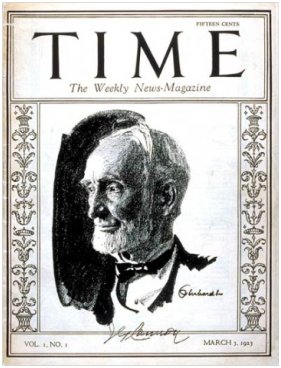
look at the premier issue of Time magazine.
[EDITOR'S NOTE: A previous iteration of Life was published primarily in the 1920's as a humor/satire rag featuring many early
Dr. Seuss cartoons and brilliant cover art but has no editorial connection to the later photojournalistic magazine most of us are more familiar with.]
I could go on, but I'm tackling the latter issue here - an historic instance of a magazine with a borderline collectible cover but a short, illustrated article shuttled to the
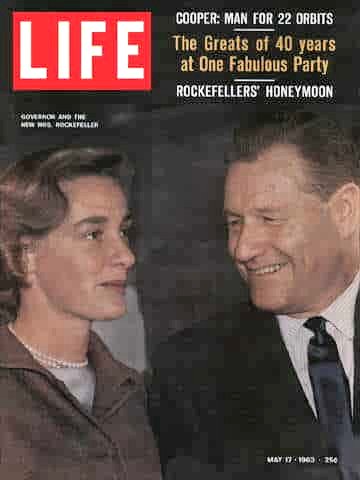
back of the magazine that contained a photo that, in some spiritual circles, shook the planet. If you're not familiar with this May 17, 1963 issue of Life magazine, here's the
cover >>>
Though I am embarrassed to admit it, in my early days I saw this issue pop up again and again over a period of years, watching it climb to outcomes typically falling into
the $30 to $50 range - to me an inexplicable price for what was otherwise a mildly interesting (if that) cover photo featuring Nelson Rockefeller on his honeymoon with his newly
minted wife, Margaretta Large "Happy" Rockefeller, who later served as second lady of the United States from 1974 to 1977. The article inside was titled "Happy's Honeymoon with Rocky."
Similar issues from this time period were doing well to rise to $5 or so. I knew that there was a scandal predating their marriage that involved infidelity, also that this scandal likely
derailed his chances of becoming President, but big deal, right? Who's going to throw $50 at this Happy chick who isn't even smiling? Who knows what Rocky was smiling about.
I can only guess.
But several years followed, and it continued to sell at these upper levels. It started to annoy me. I recall once glancing at its table of contents on the off chance that
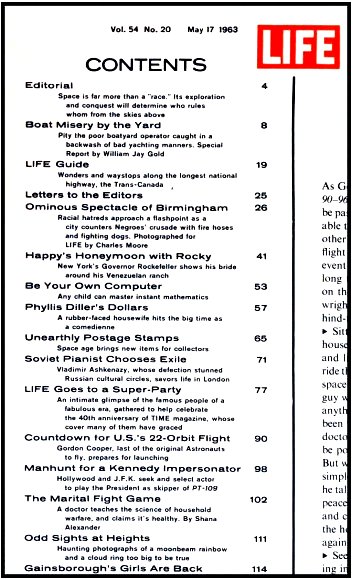
something inside it made it a grabber, but here is the table of contents I found >>>
The only thing that caught my eye whatsoever was the article, "Ominous Spectacle in Birmingham," with a subtitle "Racial hatreds approach a flashpoint as a city encounters
Negroes' crusade with fire hoses and fighting dogs." Ok, maybe this had something to do with it. It certainly was published during an historic time of racial unrest, but still.
Collectible? Understand that naïve me had begun at this stage of my so-called career to pride myself on quickly identifying items that had potential value, but this one seemed to
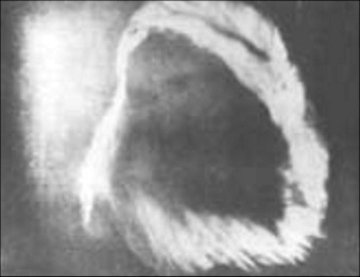
be defying me. As a last resort I eventually did a Google image search, and you know what came up? Along with various cover shots there were a bunch of photos of some lopsided
cloud that looked like they had been blown out of the mouth of somebody who had just puffed on a cigarette and was practicing making smoke rings. Oh - and another photo or two,
obviously doctored, featured an ill-defined face of Jesus inside the rings. This struck me as damned odd, so I dug deeper. Most of these cloud photos were linked to the second
to last article on the table of contents page with a throwaway title: "Odd Sights at Heights." Buried.
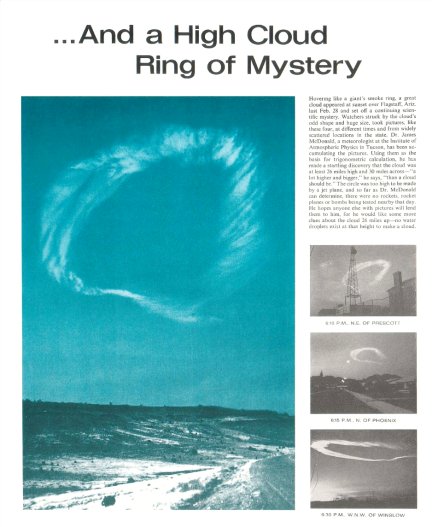
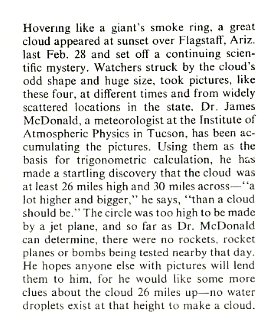
But now I was curious. And payoff came pretty quickly. Turns out that this was no ordinary cloud but a cloud that seemingly couldn't exist.
The text in this photo, if you don't have your glasses on states >>
Enter William Marion Branham. Not a household name today, but in the late 1940's into most of the 1950's he was a major evangelist, attracting tens of thousands of
spiritual seekers to his meetings. He stood shoulder to shoulder with such competitors as Oral Roberts, Billy Graham and others. With a twist. You see, not only was he
a faith healer and "Latter Rain" practitioner (look it up) but also a visionary who "saw" things and persistently associated them to prophetic outcomes. At first he did
this with visions primarily linked to people who dared to come on stage with him as guinea pigs. This was controversial enough for most of the Christian base. When these
visions became more cosmic, as in Life's "High Cloud Ring of Mystery," the controversy deepened. He "saw" this:
Branham asserted that seven angels had arrived in a pillar of cloud to proclaim God's imminent plan to deliver the return Jesus to Earth. Dr. James McDonald,
meanwhile, soldiered on for a more secular, preferably scientific explanation for why a cloud had formed at a height no conventional cloud had ever been reported to
exist. Way higher.
Time passed, and eventually an explanation came. The cloud was a huge plume of debris and rocket exhaust from a Thor rocket launch at Vandenburg Air Force Base in California,
and the rocket, in turn carried a "secret" military satellite that had failed to launch from the rocket at an altitude of approximately 26 miles.
There's much more to this story on both sides, a lot of controversy, as I said, over the Branham explanation, but at least some naysayers on the "confirmed" scientific
explanation side. The takeaway is that there are believers of both, still, and both spiritual and aeronautic collectors are attracted to this appearance in Life.
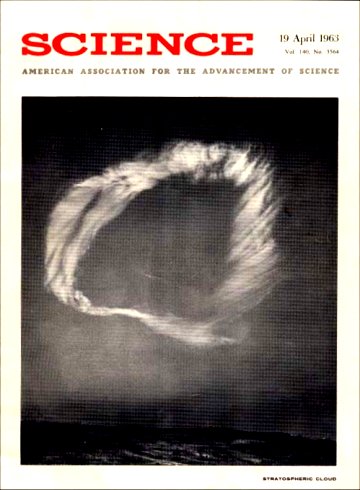
A small detail: The photo of these clouds weren't the first appeared on in a magazine. The April 19, 1963 Science magazine scooped this by nearly a full month before the May 17,
1963 Life - and even slapped it right on the cover.
Due to this priority, cover photo and scarcity, the former is more collectible than the latter, but this is an important distinction to make about marketplace values.
Life magazine enjoyed a massive subscriber base at the time; Science a much smaller one. The lesson is this: If the flashpoint is important enough to enough people - and
more accessible than its more important predecessor - values for the later and more common publication will hold strength notwithstanding. There are many, many copies of this issue of
Life out there, even today, but as long as condition isn't a major factor, grab one when you see it. It will, "annoyingly," still sell at an elevated price.
If on the longer chance the issue is in near perfect condition, ship it off to PSA, obtain a guaranteed grade that most collectors believe in, and you'll find yourself in
$$$ territory. Whatever you, do don't skimp on your sales presentation. Many do. Don't be one of them.

Copyright 2003-2026 by BookThink LLC