Where Love Has GoneThe Future of Bookselling?by Craig Stark #183 25 August 2025 |
By Craig Stark
Off and on this past year, I've spent some time reading or listening to advice on how to make money selling books online. Insofar as some of these sources can be
vetted, I've attempted to focus on sellers who seem to have made a relatively significant amount of money for at least some period of time, say, a few years or more and, on
the platform they use to offer their suggestions (YouTube, Facebook, etc.), have attracted a significant following, perhaps reaching thousands. There's no need to mention
any of their names. It's easy to find them. Lots of them.
When I began selling books online in the late 1990's, things were dramatically different in some ways but in many ways, curiously, not. The most glaring difference was that
there weren't anywhere near the number of competing sellers. Or bookselling venues. Or buyers, for that matter. eBay was in its infancy; Alibris, having begun life in 1983 as
Interloc via founder Richard Weatherford for primarily antiquarian booksellers, was clearly the earliest, most conspicuous and successful venue in the midst of nearly no
competitors; and Amazon? Jeff Bezos founded it in 1994 with a focus exclusively selling, of all things, books. Brand new ones. For the time being, that was it. And then it grew
in size both in traffic and product offerings - and it took on third-party sellers, including their books, new or used. And grew more. And grew more yet into selling what now
seems like anything and everything. Remarkably, all three of these venues exist still, today, over 25 years later, in varying sizes and degrees of success: Alibris, a shadow of
its former self, moving toward extinction; eBay, now a very large, messy presence, still viable but rumored to be inching in a somewhat aimless, if not southerly, direction;
and Amazon, so big as to be feeling the chilly breath of monopoly hunters closing in. And I should mention AbeBooks, launched in 1996, and falling somewhere in the middle of
all this but still here as well, limping. Many other bookselling venues have arrived in the interim. Most have failed, and the rest have achieved at best modest
and/or temporary success.
Another difference then was in how books were sourced for resale. We newbie booksellers guessed a lot then, largely by instinct, looking in open shop bookstores (especially
those that had yet to establish an online presence, or even awareness), in thrift stores, at library sales, estate sales and garage sales, and so on. Believe it or not, I recall
running newspaper ads for books. Boy, that'll make you feel old. But it worked! For a while.
But then, pioneer bookseller/developer Dave Anderson fundamentally changed the dynamics of sourcing, though he's rarely given the credit he deserves, and ScoutPal was introduced,
a new product available by subscription that enabled one to look up, in the field by way of scanning ISBN's, online prices for books selling on Amazon, wherever you could get a phone
connection. Fast on its heels were PDA scanners and more, which enabled you to search a periodically updated database wirelessly. No exaggeration: A new world began. At first growth was
slow, but not so gradually, over the years, scanners became a necessity if you had any hope of competing. Refinements followed, primarily metric. They do it all now, supply current
prices, historical prices, price trends, sales rankings and more. And they do it fast as long as there are bar codes to shoot. And many make buying decisions for you.
As a rule, I don't feel an inclination to talk about the future, not because I'm not interested in it, but primarily because it's almost entirely guesswork. I often get it wrong.
In the dawn of the tech age of bookselling, which I've briefly laid out above, everywhere you turned there was somebody pontificating on - predicting - the death of bookselling, if
not books altogether. Well, it's clear that digitized books have proliferated wildly, but books? They've marched on in spite of this. Some people just like them. Prefer them.
In a sense it's similar to vinyl records, once all but given up for dead then almost inexplicably making a strong comeback. The growth of record stores is summarized thus via
Google: "Record stores have experienced a notable resurgence, particularly due to the increasing popularity of vinyl records. Since 2016, vinyl album sales have skyrocketed from
13.1 million to 49.6 million in 2023, marking a growth of nearly 300%. Independent record stores have played a significant role in this trend, accounting for 45% of all vinyl sales."
Some explain this away by citing the battle between analog and digital formats. Essentially, analog is continuous sound; digital erases the noise between notes, and cleans the
notes themselves. To the sensitive ear, analog sounds real. Digital feels sanitized. There's more. I'm sure most of us who lived through the 60's and 70's recall a friend or perhaps
yourself who approached vinyl music almost as a religion. The various components to play a record, which could be obscenely priced, by the way, and the act of playing a record often
involved a kind of reverent ritual, carefully removing record from its internal sleeve after making adjustments on amplifiers, etc., wiping it with a microfiber cloth so that not a
speck of dust would meet the needle and contaminate a groove, then, cradling it, fingers on the edges, laying it on the turntable as though it was a fragile artifact, then lifting
the needle and slowly lowering it into the lead in area so as to track a groove smoothly and avoid any skipping that could damage the record. Few automatic needles were tolerated.
Similar things take place with serious book collectors, not daring to pull a book off a shelf by pulling on the head of its spine panel and yeanking it forward but instead inserting
fingers at about mid spine and sliding it out gently, either wearing white gloves when handling it, or growing finger nails to safely turn a page with. Or both. And don't forget periodic
dusting, leather preservative applications, and on it goes.
Like vinyl records, print books haven't gone away. Far from it. And compare the book collector's ritual to a modern bookseller digging into a Goodwill trash bin, grabbing books
piled every which way, briefly scanning bar codes and either tossing the discards back into the garbage or dropping the keepers into a stack on the floor. It's a jolting activity.
Ask this person what they do for a living, and most will answer, "I'm a bookseller," but you don't have to dig much deeper to discover that they're really dumpster divers, scanner
button pushers, camera snappers, packers, and so on. What do you call this species of bookseller? Some don't even use more than a bloated, copied AI description to sell their finds,
if that, and often inform you that the photos attached to their listings are their descriptions. Is this a "trade" you want to build a career on? A child could be taught to do as
much, and if what had to be done with almost all of their time was this tedious activity, a burnt out child. And still the smell of money is everywhere. Exciting. At first.
If any of the above fits you, how you buy and sell books, have you ever stopped to think about how you spend your time specifically? Hour by hour? If you haven't already, read
the online talk. The crowded groups. How often is it about book knowledge? The intricacies of presenting them for sale? For that matter, how many homes have you walked into that
have anything that could remotely be called a library? It's almost as though we've turned are backs on this to create open spaces and mud rooms. Most books are cheaply made and
look like it at a glance. Why would you even want to collect and/or display them? If you watch home improvement shows, how few feature libraries, you know, those beautiful rooms
that once housed books and were often the centerpiece of grander homes? If by chance a decorator encounters a wall of books in the home being renovated today, they more often
than not turn them backwards to display the text blocks, not the spine panels, as if the subtle shades of paper making them up a wall portrait were works of art.
I'm not deliberately trying to be cynical here, or snooty. Nor am I denigrating what your present business model is. But if you haven't read Marshall McLuhan's The Medium is the
Message, now a decades old, an almost forgotten argument about the influence media (books, records, etc.) has over the actual message being conveyed, you could do worse than
spending a few hours with it.
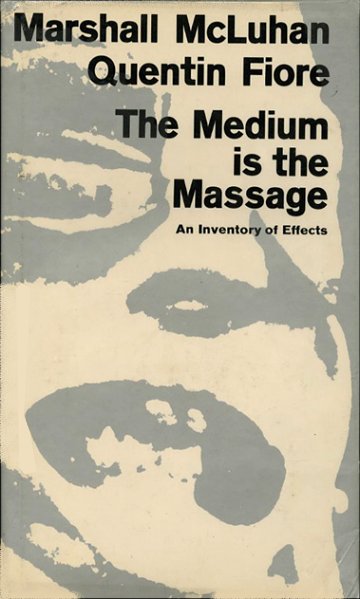
Vinyl: medium. Vinyl recording: a message substantially different than a live stream piece of digitized music. In books the argument is more subtle, but I challenge you to take any prominent book 100 or more years old and read it once in its first or early appearance in print, as issued, then read the same book today as a modern reprint with a glued binding, a flimsy cardboard cover coated with paper, and a dust jacket that looks like it was whacked together by am imaging application and may not survive a second reading. I guarantee you that the message originally offered will change, and not for the better. The modern message is designed to live in your mind almost entirely, the original message in your heart, soul and mind.
In Part II, I'll look deeper into the change, why it might matter to your long-term survival in the trade, and attempt to show you where love has gone. Oh - and with apologies
to Harold Robbins, who may or may not have anything to do with it.
Copyright 2003-2025 by BookThink LLC