|

<<< Continued from previous page It's probably easiest to start shading in your chart with your planned wall shelves. If you haven't already chosen fixtures, then you'll have to guesstimate on widths and footprints. Usually individual bookcases will not be more than 4 feet in length as books are heavy and will bow shelves that are too long. If your shelves will be straightly vertical and hold a mix of paperbacks and hardcovers, then use 12-14 inches of width. The average fiction hardcover is 9 inches wide and you'd like a couple of inches of empty shelf space, plus the depth of the back of the case. My cases, however, angle out at the bottom and so have a wider footprint.
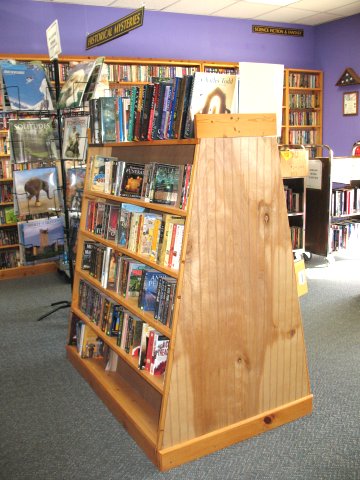
If you are planning on including a children's area, you may wish to pencil it in next. Some owners like to keep the children's area in view from the cash wrap. I decided that seeing the mess as it was being made would make me grumpy, so I angled my children's area so I couldn't see directly in and placed it in the back corner of the shop. This also provides some security as children straying out of the area are as far from the front door as they can be, giving parents longer to catch them. My children's area is an enclosed nook with only a single entrance/exit for parents to monitor. It can get a little cramped if you have more than one family in it at a time, though. If you will be holding events, plan out your event area. You may want that area to have easy access to an electrical plug for microphones, audiovisual equipment, etc. If your event area is not against a wall, contact an electrician and see if a floor outlet can be installed. If your store is small, you may need to put your floor fixtures on castors so that you can easily move them around to create event space as needed. When setting up your interior aisles, you can set them up horizontally, vertically, at an angle, or in a maze of cul-de-sacs. Cut out to-scale fixtures and play around with different combinations. If your shop has typical rows of fluorescent lighting, you may wish to center your aisle walkways on the lights so as to maximize visibility. You may also want to take into account the sun glare from any windows and angle your aisles so that the ends take the brunt of nature's rays. If you are starting with minimal inventory and planning to grow over time, you may want to start with wider aisles and add an extra row of floor fixtures later (this will be a lot easier if you put your fixtures on castors). Or you could temporarily include large, comfy chairs that you may prune down over time. When penciling in your cases, you should also be thinking about display space. I feel that approximately 15-25 percent of your available space should be used for display. A long wall of bookcases filled with books can be intimidating, even if you use a faceout on every other shelf as recommended. I like to break up the space by using shelves at eye height as display areas or even an entire case of display. Also, plan to use leftover wall space that won't accommodate a full case for more display. Some of your displays may be permanent and others will be seasonal and get switched regularly. Examples of permanent displays could be a Staff Picks area (the area is always there even though the individual titles may get changed out regularly) or a display of Modern Library's list of 100 Best Novels. Leave room for endcap displays on your aisles. If your fixtures are slatwall, then you can build the display directly onto the case. Otherwise, you'll need a table or other fixture. If your store has plate glass windows, you'll also need to leave room for enticing window displays that will lure customers into your shop.
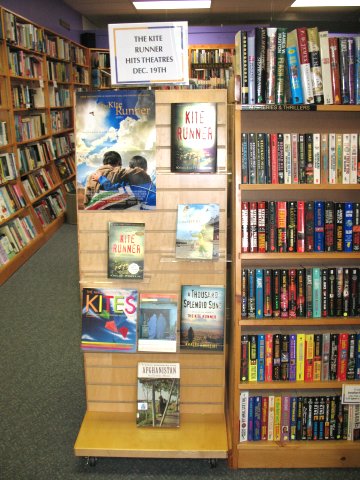
Make sure to pencil in display areas near where customers will be waiting in line at the cash wrap. They'll have nothing better to do than look at whatever you're featuring. The point of a display is to spice up the monotony of your standard fixtures and draw the eye, so get creative and use tables, antique furniture, or anything else you can think of. If you will be carrying non-book items, consider purchasing the fixtures recommended by the vendor rather than using your standard shelving. The vendor has usually done a lot of research into what sells their product the best, and a little variety in your fixtures can go a long way in making your shop into an interesting place to visit. Keep in mind, though, that these fixtures may be nearly as large as one of your regular bookcases. My puzzle rack from Melissa & Doug takes up a circular area 3 feet in diameter, and my calendar spinner is almost as large. Plan for the future and think about where you might include bargain books or a sale table. I was initially opposed to the concept of bargain books, but I've found that it's nice to have a legitimate response to the complaints of extremely price-sensitive customers: "Did you see our bargain book section; paperbacks are only $1.00 each." Conventional wisdom states that bargain books should be place outside on carts or in a vestibule space to lure customers in (these strategies have worked very well for us) or at the back of the store to ensure that your customers will see most of your store on their way to it. Once you've got a general idea of how many cases you can fit in, estimate your total linear feet of shelf space (i.e., if you have a four-foot-wide case that holds six shelves, that case has 24 linear feet of shelving) and multiply it by the different percentages you assigned for each section. Then start divvying up the shelves. Ideally, sections should take up entire fixtures, rather than having a case containing the end of one section and the beginning of another. Also, you'd like the sign for each section to be visible from the door, if possible. You may also have sections that you'd like to be near each other, e.g., True Crime near Mysteries. Don't get too attached to your chart, though. This is just your starting premise. I've moved just about every section in my store at least once, changed the spacing of my aisles, added more fixtures, removed fixtures, etc. If you decide on fixtures with fixed shelving, keep in mind that sooner or later you're probably going to want to put something else on that fixture, and the shelving may not accommodate it. Also, try to implement a signage system that will easily support changes. Before finalizing your chart, you will need to make sure you know the exact measurements of the fixtures you will be using. Even if you are having them built to specification, make sure to run those specifications by your carpenter to make sure that what you have in mind is feasible. In order to plan properly you will need to know the footprint of the fixture, its height, and its capacity (i.e., five fixed mass-market shelves or adjustable shelving that will hold eight shelves at mass-market, six at hardcover spacing, and five at art-book spacing). Stay tuned for Part II of this article, when I will specifically address the issue of fixtures. If you have any questions about laying out your store, please email me at fictionaddiction@juno.com or post your query to the BookThink Open Shop Bookstores Forum and I'll do my best to help.
Questions or comments?
| Forum
| Store
| Publications
| BookLinks
| BookSearch
| BookTopics
| Archives
| Advertise
| AboutUs
| ContactUs
| Search Site
| Site Map
| Google Site Map
Store - Specials
| BookHunt
| BookShelf
| Gold Edition & BookThink's Quarterly Market Report
| DomainsForSale
| BookThinker newsletter - free
Copyright 2003-2011 by BookThink LLC
|

|
|



 If you liked this article, Digg it!